National Veterinary Institute DTU conducts research in infectious diseases in livestock and makes diagnoses in diseased animals. We give advice to public authorities and cooperate with them on the Danish veterinary contingency plan. We are reference laboratory in a number of areas.
National Veterinary Institute DTU encompasses all infectious animal diseases in farm livestock and companion animals. Our main focus is on notifiable diseases, as well as other serious infectious diseases that affect farm livestock.
Our tasks concern:
We do research in diseases
The Institute does research in methods to detect, control and prevent infectious animal diseases. Our research activities cover a wide field, i.e. developmental and application-oriented projects as well as basic research.
The institute also hosts an international research centre for veterinary epidemiology, International EpiLab.
We diagnose
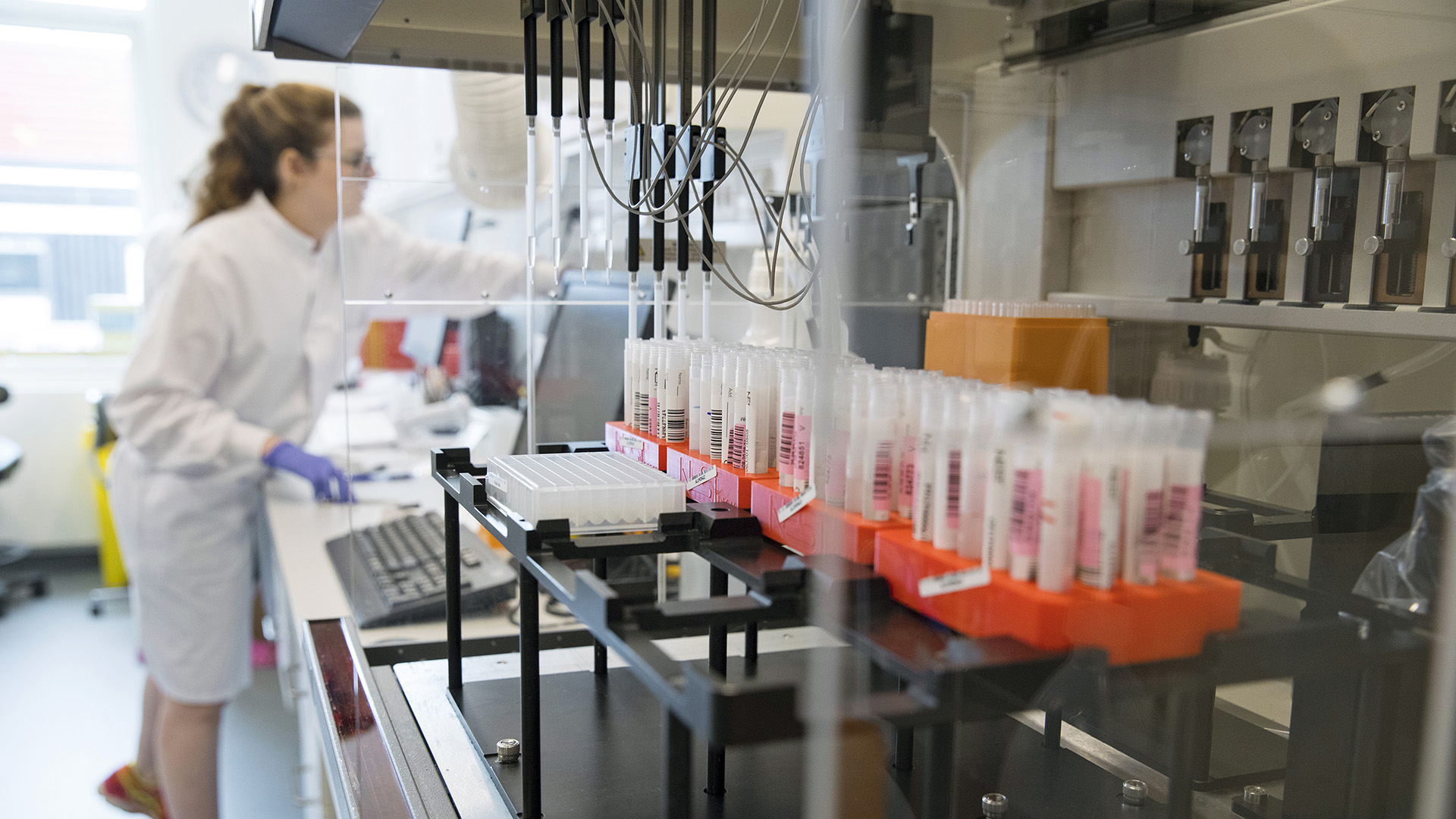
Veterinarians can submit samples from diseased animals to be diagnosed. For notifiable diseases the diagnosis is free, whereas we diagnose other diseases on commercial terms. All our diagnostic services are based on accredited or quality-assured analysis methods.
We manufacture vaccines and sera
For some animal diseases commercial vaccines and sera are not available. For the treatment of these diseases the National Veterinary Institute DTU manufactures vaccines and sera, if the disease is significant. Our production of vaccines and sera takes place on commercial terms.
We give advice to public authorities
The National Veterinary Institute DTU provides advisory services and risk assessment to public authorities, the industry and interest groups. Advisory services and risk assessment are both based on robust and sensitive research methods. In addition, we supply data for disease monitoring in Denmark and coordinate the national monitoring of veterinary drug use (Vetstat).
We are responsible for the Danish veterinary contingency plan
The National Veterinary Institute DTU is responsible for the laboratory component of the Danish veterinary contingency plan, which puts emergency procedures into action in the event of suspected or actual outbreaks of serious infectious animal diseases. In these cases our laboratories analyse samples from the animals. The contingency plan is supported by our activities in conjunction with a range of national monitoring programmes on animal diseases and zoonoses. Our research and diagnostics expertise is crucial for maintaining the high quality of the Danish veterinary contingency plan.
The Danish Veterinary and Food Administration is responsible for the part of the contingency plan handling infection situations in Denmark.
We are reference laboratory
The institute is the Danish national reference laboratory for a long list of infectious animal diseases, and the EU and OIE reference laboratory for selected fish diseases.
We cover relevant subject areas
Professionally the institute covers all areas important to infectious diseases:
-
Pathology
-
Bacteriology
-
Virology
-
Parasitology
-
Immunology
-
Vaccinology
-
Serology
-
Epidemiology
-
Risk Assessment
We are 220
The institute employs about 220 staff members and consists of the management, the secretariat and the service division. Furthermore we have these five sections:
-
Virology – focusing on serious virus infections, including virus infections transmitted from animals to humans (zoonotic infections).
-
Immunology and vaccinology – including deve-lopment and optimization of new vaccines and other biological products.
-
Epidemiology – including disease modeling and climate-related changes in disease spread.
-
Bacteriology, pathology and parasitology - focusing on fish bacteriology, non-food-borne bacterial zoo-noses and activities with a view to reducing the use of antibiotics. We also work on methods for characterizing multi-bacterial societies.
-
Public sector consultancy, contingency and commercial diagnostics.